RALUCA’S STORY
despite a severe diagnosis and an unpredictable progression, Raluca remains a symbol of courage – her story is one of struggle, love, relentless effort, and hope for a treatment that could give her life back

According to the medical information we initially received, Raluca, 45 years old and the mother of two boys aged 14 and 16, was diagnosed on October 19, 2023, with a grade 3 diffuse frontal-temporo-parietal glioma, with the following characteristics: LDH1+2 negative, ATRX positive, Ki67=10%, and p53 positive, without 1p19q codeletion, and MGMT negative.
She underwent a brain biopsy on November 14, 2023, followed by radiotherapy and chemotherapy with temozolomide (TMZ) between December 17, 2023, and January 29, 2024, completing two cycles of chemotherapy with TMZ by March 29, 2024.
Between March 12-20, 2024, Raluca was urgently hospitalized due to an acute intracranial hypertension syndrome. After being discharged on March 26, 2024, she was prescribed dexamethasone treatment according to the report issued by the neuro-oncologist. Unfortunately, on April 8, 2024, my wife suffered an ischemic stroke, was urgently hospitalized again, and was discharged on May 14, 2024.
On the day she was discharged, May 14, 2024, she could not get out of bed by herself and required full-time care and assistance.
On May 14, 2024, she had an MRI that showed no sequelae after the stroke, and on May 15, 2024, she received her first 600 mg dose of Bevacizumab.
After Bevacizumab, the reactions were unexpectedly good, and her condition began to improve dramatically day by day.
Starting May 20, 2024, she also began physiotherapy with a specialist.
On June 3, 2024, she received her second 600 mg dose of Bevacizumab, and from June 18, 2024, she resumed the temozolomide treatment.
On August 15, 2024, she had an MRI after 4 cycles of 600 mg Bevacizumab, and the results were very good.
After August 15, 2024, she continued with 2 more cycles of temozolomide, and a new MRI was scheduled for November 15, 2024.
During this period, she had a Karnofsky score between 90 and 100, with no issues or pain.
The doctors told her that she had recovered very well, including from the area affected by the stroke.
On November 15, 2024, the MRI showed early signs of progression outside the initial treatment field, with recurrence of the disease in the right frontal area, showing subcortical nodular contrast-enhancing areas as well as a linear hyperintense area in the left frontal subcortical white matter.
It was decided to resume administration of 600 mg Bevacizumab and 340 mg Temozolomide, with a new imaging evaluation scheduled for January 14, 2025.
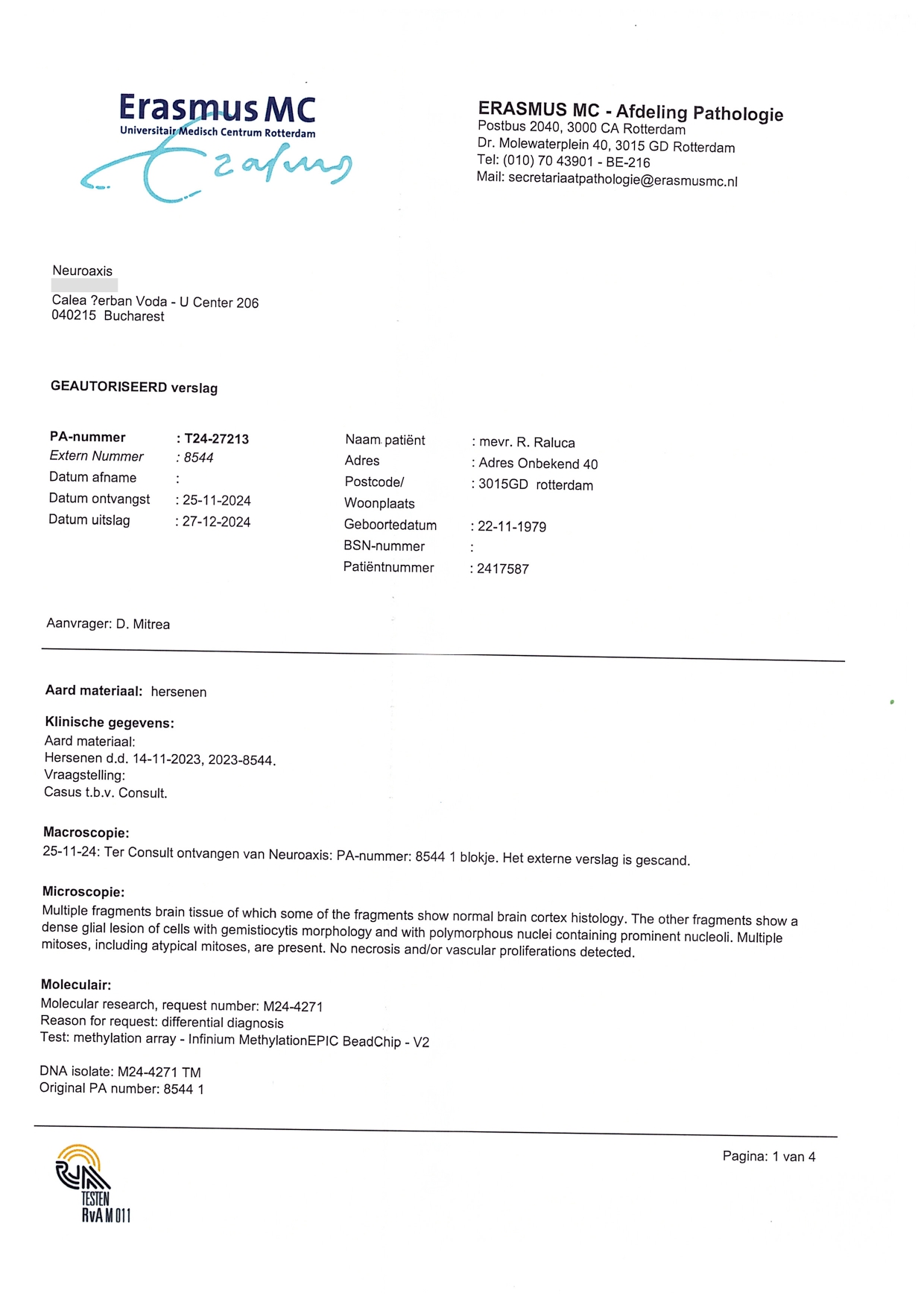
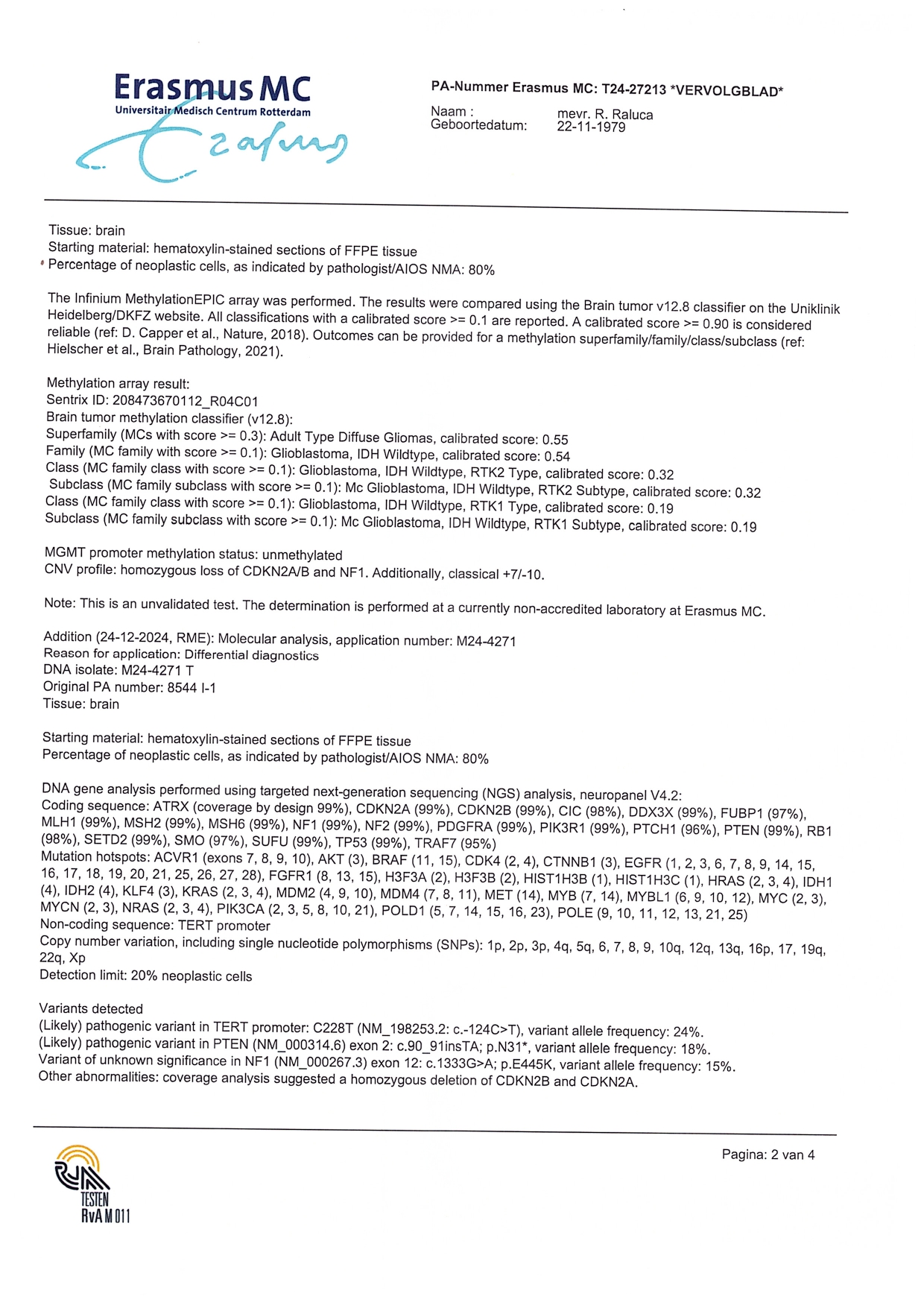
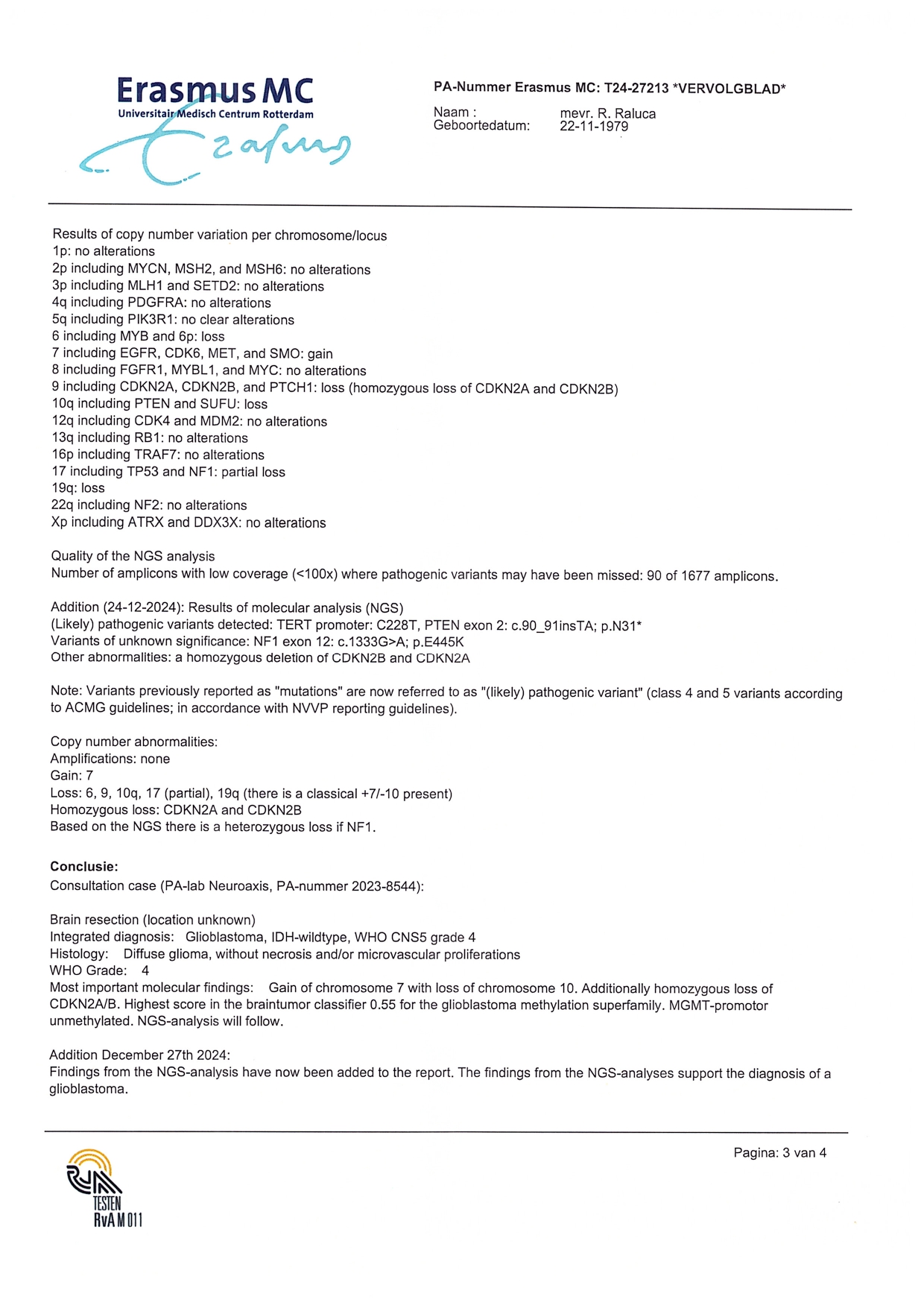
At the same time, we requested an NGS analysis from Erasmus MC in the Netherlands.
Unfortunately, the results from Erasmus MC were not encouraging and confirmed a diagnosis of Glioblastoma IDH-wildtype WHO CNS grade 4. Until then, based on previous analyses in Romania, we had believed it was a diffuse wildtype astrocytoma grade 3. Moreover, the Erasmus panel revealed complex genetic mutations (including NF1, PTEN, SUFU, MYB, TERT, and 6p), unmethylated MGMT, GFAP positive, p53 positive, retained ATRX, and negative EGFR.
On January 14, 2025, compared to November 15, 2024, the MRI showed new lesion changes in the white matter, subcortical, bilateral frontal (gadolinium-enhancing on the right side) distant from the initial treatment field, and a new lesion change within the initial treatment bed.
She was prescribed continuation of treatment with 600 mg Bevacizumab, and Lomustine 90mg/m2 for 2 cycles. Temozolomide was discontinued, and an oncologist told us that after Lomustine there is nothing else and that it is anyway less effective than Temozolomide.
The first cycle of Lomustine was administered on February 4, 2025. The second cycle of Lomustine was administered on February 26, 2025.
On March 11, 2025, she had a new MRI which showed disease progression compared to the MRI from January 14, 2025. Given that the NGS panel revealed a mutation on the NF1 gene, she was prescribed Trametinib. However, after 10 days of Trametinib (Mekinist) administration, she developed an adverse reaction with an acneiform rash and had to stop taking it.
Between March 11, 2025, and June 27, 2025, her health condition deteriorated rapidly, and she became bedridden, unable to move her left arm and leg, unable to eat by herself, and gradually lost her vision after each Bevacizumab administration.
The whole family was by her side, and we did everything possible to provide her with all the necessary care for someone in her medical condition.
On June 28, 2025, we had to admit her to the hospital because she developed aspiration pneumonia, and we could no longer provide specialized medical care at home.
Meanwhile, we learned about the EXACTA test and the possibility of testing (chemosensitivity + pharmacogenetics + toxicity) for additional medications beyond those included in the standard panel. We have done this test and are now awaiting the results from the laboratory.
Additionally, we have had discussions with representatives of the manufacturer of a dendritic cell vaccine, DCVax-L (autologous dendritic cell vaccine). However, the costs are extremely high and far exceed the family’s financial means.
Just the production and administration of the vaccine in the first year costs approximately £100,000. This cost is in addition to leukapheresis (£6,000-8,000), hospitalization in the UK, travel to the UK for the 6 doses administered in the first year, and any other fees charged by the medical facility in the UK. Subsequently, the costs are approximately £50,000 for each additional year.
However, with the support of kind-hearted people, I hope that we can consider this option too if the EXACTA test identifies potential therapies that could help bring Raluca back to a condition where she could undergo the DCVax-L vaccine treatment process.
Raluca’s journey will continue for as long as we can do something for her and as long as it is God’s will.
Medical Letter – Erasmus University Medical Center – December 2024